When Should You Replace a Motorcycle Brake Hose?
Motorcycle brake hoses are critical components in a hydraulic braking system. They transfer brake fluid pressure from the master cylinder to the brake caliper, so their condition directly affects the reliability of the braking system.
Many riders only consider replacing a brake hose when they notice a fluid leak. However, a motorcycle brake hose can also become unsafe because of cracking, abrasion, swelling, corrosion, twisting, excessive heat, or aging.
This guide explains when a motorcycle brake hose should be replaced, what warning signs to look for, and when upgrading to a high-quality or a performance-oriented may be appropriate.
How Long Does a Motorcycle Brake Hose Last?
There is no single replacement interval that applies to every motorcycle brake hose. Service life depends on the hose material, vehicle usage, climate, routing, heat exposure, road conditions, maintenance, and installation quality.
A motorcycle used frequently in hot, humid, rainy, dusty, or coastal environments may experience different hose aging conditions from a motorcycle used occasionally in a dry climate.
For this reason, condition-based inspection is more useful than relying only on mileage or a fixed number of years.
Factors That Can Shorten Brake Hose Service Life
- Repeated exposure to high temperatures
- UV and environmental exposure
- Water, dirt, road chemicals, and contaminants
- Repeated twisting or bending
- Contact with suspension or steering components
- Incorrect hose routing
- Excessive mechanical vibration
- Aging of the inner tube or outer cover
- Corrosion around fittings and ferrules
- Previous incorrect installation
7 Signs That a Motorcycle Brake Hose Needs Replacement
1. Cracks on the Outer Surface
Small cracks on the outer surface of a brake hose should not be ignored. Cracking can be associated with aging, mechanical stress, environmental exposure, or incorrect installation.
If cracks become deeper or the reinforcement becomes visible, the hose should be replaced rather than reused.
Regular visual inspection is especially important for older motorcycles and motorcycles that are frequently exposed to sunlight, rain, mud, or high temperatures.
2. Brake Hose Bulging Under Pressure
A brake hose that visibly expands or bulges when the brake is applied is a serious warning sign.
Bulging indicates that the hose structure is no longer maintaining its intended shape under hydraulic pressure. A damaged hose can affect hydraulic pressure transmission and may become a failure risk.
If a motorcycle brake hose shows abnormal bulging, replacement should be considered immediately rather than continuing to monitor the hose during normal riding.
3. Brake Fluid Leakage Around the Hose
Brake fluid around the hose, fitting, banjo connection, or crimped area can indicate a sealing or hose problem.
Do not assume that every leak comes from the hose itself. The fitting, sealing washer, connection thread, or caliper may also be responsible.
However, any confirmed hydraulic brake fluid leak should be investigated before the motorcycle is returned to normal operation.
4. Severe Chafing or Abrasion
Brake hoses should not continuously rub against the front fork, frame, wheel, suspension components, or other moving parts.
Continuous contact can gradually damage the outer cover and eventually expose the reinforcement layer.
This problem is particularly common after motorcycle modifications when the handlebars, front fork, caliper, or suspension configuration has been changed.
When replacing the hose, the routing should be checked throughout the complete steering and suspension movement range.
5. Twisting, Kinking, or Excessive Stretching
A brake hose should be installed without unnecessary twisting or sharp kinks. It also needs sufficient length to accommodate steering and suspension movement.
A hose that is too short can become stretched when the handlebars are turned. A hose that is incorrectly oriented can also twist around a fitting.
For modified motorcycles, choosing the correct hose length and fitting orientation is particularly important.
6. Corrosion Around Fittings and Ferrules
Brake hose problems are not limited to the flexible hose itself. The fittings, ferrules, banjo connections, and other metal components should also be inspected.
Corrosion can become more serious in humid, rainy, coastal, or high-salt environments. This is particularly relevant for motorcycles used in Southeast Asia and other regions with high humidity.
If corrosion has significantly weakened a fitting or connection, replacing the complete brake hose assembly may be more appropriate than replacing only one component.
7. The Brake Hose Is Old or Its Condition Is Uncertain
A motorcycle with an unknown maintenance history should receive a careful brake hose inspection before being used regularly.
This is especially important when buying a used motorcycle, restoring an older motorcycle, or modifying a motorcycle with an unknown brake system history.
If the hose shows multiple signs of aging or the previous service history cannot be confirmed, replacing the brake hose can be a practical way to establish a known baseline for the braking system.
Should You Replace the Brake Hose With Another Rubber Hose?
Replacing a damaged hose with a suitable replacement hose can restore the hydraulic connection when the original specification is appropriate for the motorcycle.
However, motorcycle owners who are already replacing old hoses may also consider different hose constructions depending on their application.
For example, a properly designed can be suitable for many standard applications, while stainless steel braided or PTFE-based brake hose assemblies are commonly selected for modified motorcycles and performance-oriented applications.
Why Do Motorcycle Riders Upgrade Their Brake Hoses?
Brake hose replacement and brake hose upgrading are not exactly the same thing.
A replacement restores the required connection using a suitable hose. An upgrade may involve a different hose construction, reinforcement, fitting configuration, color, or custom routing.
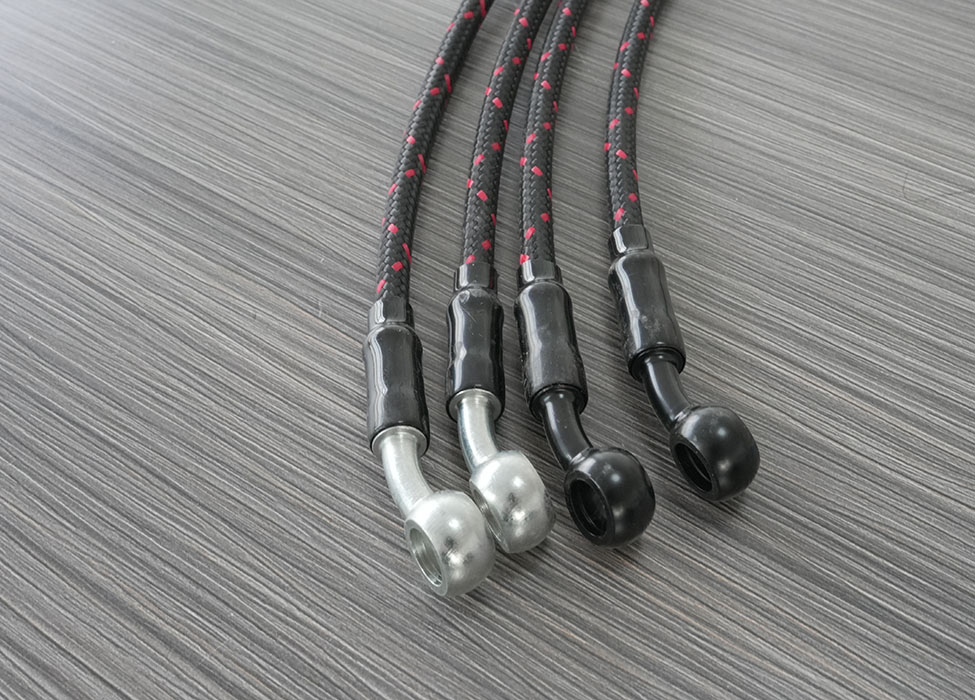
For modified motorcycles, riders may choose a , or other custom-color brake line to combine functional requirements with the appearance of the motorcycle.
The important point is that color should never replace technical compatibility. Hose material, pressure capability, fitting type, thread specification, length, routing, and sealing method all need to be correct for the application.
When Should You Consider Stainless Steel Braided Motorcycle Brake Lines?
Stainless steel braided brake lines are often considered when a motorcycle owner wants a more specialized brake hose configuration or is already replacing aging original hoses.
A braided construction can provide additional mechanical reinforcement around the inner hose. The actual performance of the complete brake system still depends on the hose construction, fittings, installation, routing, brake components, and overall system design.
For riders looking for a custom appearance, options such as can be specified when the product configuration supports the application.
Brake Hose Replacement Checklist for Motorcycles
Before ordering a replacement or upgraded motorcycle brake hose, check the following specifications:
- Motorcycle make and model
- Front or rear brake application
- Required hose length
- Hose inner and outer construction
- Fitting type
- Thread size and pitch
- Banjo bolt specification if applicable
- Fitting angle
- Fitting orientation
- Sealing washer requirements
- Brake system and ABS compatibility where applicable
- Required hose routing and bending radius
- Operating temperature and pressure requirements
What Should B2B Buyers Check When Sourcing Motorcycle Brake Lines?
For distributors, motorcycle parts importers, workshops, and aftermarket brands, checking only the hose color or outside diameter is not enough.
A reliable purchasing specification should include the complete hose assembly configuration.
Recommended B2B Specification List
- Hose material and construction
- Inner diameter and outer diameter
- Reinforcement material
- Fitting material
- Fitting thread specification
- Banjo angle and orientation
- Hose length tolerance
- Crimping or assembly method
- Pressure testing requirements
- Color options
- OEM or custom packaging
- Sample approval before mass production
For buyers who need different hose constructions, options such can also be evaluated according to the motorcycle application and technical requirements.
Motorcycle Brake Hose Inspection: A Simple Routine
Visual Inspection
Inspect the complete hose from the master cylinder to the caliper. Look for cracks, abrasion, swelling, leakage, corrosion, kinks, and abnormal deformation.
Check Hose Movement
Turn the handlebars through the normal steering range and check whether the hose becomes stretched, twisted, trapped, or rubbed against another component.
Check Fittings and Connections
Inspect banjo bolts, fittings, sealing washers, and crimped areas for leakage, corrosion, looseness, or visible damage.
Check After Motorcycle Modification
Any change to handlebars, forks, calipers, suspension, wheel configuration, or brake components can change hose routing requirements.
After modification, the brake hose should be checked through the complete range of steering and suspension movement.
When Should You Replace a Motorcycle Brake Hose?
There is no need to wait for a brake hose to completely fail before replacing it. Visible cracking, serious abrasion, bulging, leakage, severe corrosion, kinking, stretching, or other significant deterioration are clear reasons to investigate replacement.
For older motorcycles or motorcycles with unknown service history, a detailed inspection can help determine whether the existing hose remains suitable.
For modified motorcycles, replacing an aging hose is also an opportunity to select the correct hose construction, fitting configuration, length, color, and routing for the new setup.
Whether you are sourcing standard replacement hoses or customized products for the aftermarket, the complete brake hose assembly should be specified according to the actual motorcycle application rather than by appearance alone.
Final Thoughts
Motorcycle brake hoses are safety-critical components and should be inspected regularly. Cracks, bulging, leakage, excessive chafing, twisting, stretching, corrosion, and deterioration are important warning signs.
When replacement is required, selecting the correct hose material, fittings, length, routing, and sealing configuration is just as important as choosing the hose itself.
For motorcycle parts distributors, workshops, importers, and aftermarket brands, a properly specified or customized motorcycle brake hose can provide a practical solution for different replacement and modification requirements.