When Safety Lines Fail- A Deep Dive into the Science of Brake Hose Deterioration
When Safety Lines Fail: A Deep Dive into the Science of Brake Hose Deterioration
As a manufacturer supplying performance brake lines globally, we've analyzed thousands of failed hoses. A brake hose isn't just a tube; it's a precision-engineered hydraulic component. Its failure is predictable and rooted in material science. This article explains the primary failure modes, moving beyond simple "wear and tear" to the chemical and physical processes that compromise your safety.
The Three Pillars of Failure: A Structured Analysis
Brake hose failure is not random. It follows specific pathways dictated by the hose's construction and its operating environment.
1. Internal Delamination and Swelling (The Silent Killer)
This is the most insidious failure, common in standard multi-layer rubber hoses. The hose consists of an inner tube, a reinforcing fabric or steel mesh, and an outer cover.
- The Process: Over time, heat and contaminated brake fluid (which becomes acidic) attack the bond between the inner tube and the reinforcement. The inner rubber softens and separates, creating flaps or debris that restrict fluid flow.
- The Symptom: A spongy pedal that may progress to a hard pedal as flow becomes restricted. It can also cause brake drag, as fluid cannot fully return to the master cylinder, keeping pressure on the caliper.
- The Root Cause: Material incompatibility and chemical breakdown. Standard rubber is not fully impervious to modern glycol-based brake fluids over the long term.
2. External Environmental Attack: Cracking, Abrasion, and UV Damage
The outer cover is the first line of defense, and its failure exposes the vulnerable reinforcement beneath.
- Ozone & UV Cracking: In sunny climates (Middle East, Africa), ozone and ultraviolet radiation break down the rubber's polymers, creating surface cracks. These cracks deepen, exposing the braid to moisture and abrasion.
- Abrasion: Physical rubbing against chassis components, especially in off-road or high-vibration applications, wears through the cover.
- Chemical Attack: Oil, fuel, or road salt can soften or degrade the outer rubber.
Once the braid is exposed, it corrodes (in the case of steel) or frays, leading to a catastrophic loss of pressure integrity.
3. Fitting and Crimp Failure: The Weakest Link
The point where the hose meets the metal fitting is a critical stress concentration. Failure here is often due to:
- Improper Crimping: A sub-standard crimp can fail under cyclic pressure loads.
- Corrosion: Fitting corrosion, especially in coastal or salted-road environments, weakens the connection and can lead to leaks.
- Stress from Twisting or Over-Bending: Incorrect installation puts constant strain on the crimp joint.
The Engineering Solution: Building Hoses That Resist These Failures
Our approach is to engineer hoses that specifically counteract these failure modes. We move from reactive replacement to proactive design.
Material Evolution: From Reactive Rubber to Performance Polymers
- Eliminating Internal Degradation: We use PTFE (Teflon) as the inner liner in our performance lines. PTFE is chemically inert, non-reactive with all brake fluids, and has an ultra-smooth bore that prevents debris adhesion. It cannot swell or delaminate.
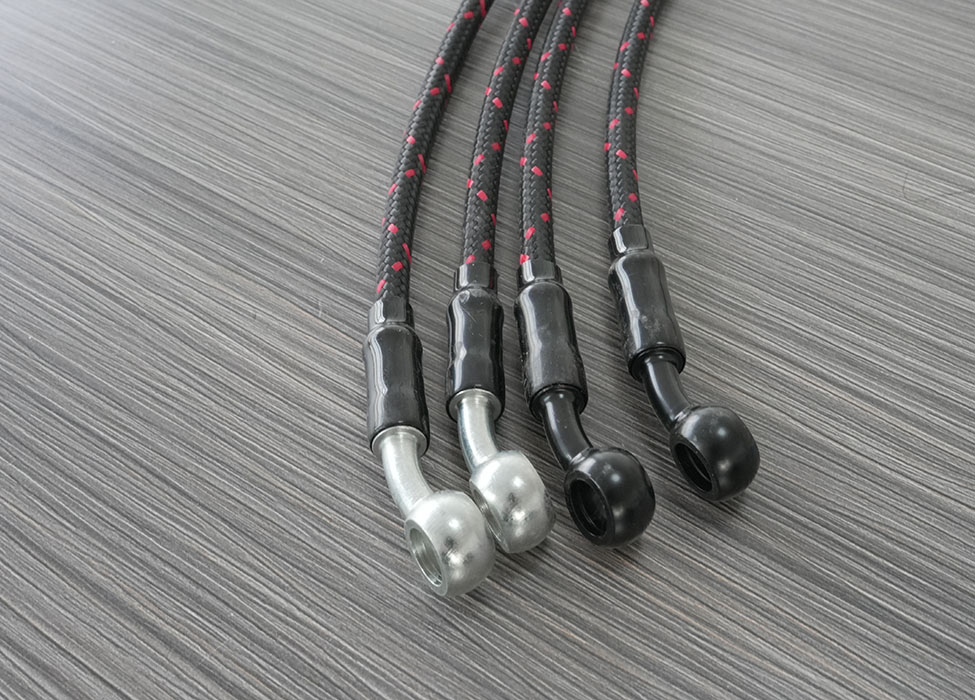
- Armoring Against the Environment: The PTFE core is sheathed in a high-density, 304-grade stainless steel braid. This braid provides immense tensile strength and acts as a sacrificial armor against abrasion, impact, and UV rays. This is the core of all our colored braided lines.
- Fortifying the Terminations: We use forged, precision-machined fittings (not cast) and employ automated, high-pressure crimping machines. Each crimp is a cold-formed, permanent union that exceeds the burst pressure of the hose itself.
Our Color-Coded Performance Range: More Than Aesthetics
Our colored brake lines are not just for show. The vibrant anodizing or PVC coating over the stainless steel braid provides an additional layer of environmental protection, especially against UV rays. Each color serves the same high-performance standard but caters to different applications:
All these technologies are also applied in our dedicated
Motorcycle Brake Lines, where reliability is even more critical due to the vehicle's dynamics.
Maintenance and Inspection Protocol
Visual Inspection (Every 6 months/10,000 km): Look for cracks, deep abrasions, or bulges on the hose. Check for wetness or crusty deposits at fittings.
Functional Test: With the vehicle safely raised and wheel off, have an assistant press the brake pedal firmly. The hose should not swell or pulse. Any movement indicates imminent failure.
Fluid Service: This is non-negotiable. Flush the entire system with new, high-quality DOT 4 or 5.1 fluid every two years. The fluid is the lifeblood and its condition dictates the internal health of all components.
Have a Failed Hose or a Custom Application?
If you have a hose that has failed in a specific way, or a vehicle that requires a non-standard solution, we can reverse-engineer a better product. Send us the failed part or your detailed specifications. Our engineering team can analyze the failure mode and produce a hose that addresses the specific weakness. Contact us through our website to start the process.
 2026-2-2