The Hidden Culprit Behind a Spongy Brake Pedal: Understanding Brake Line Expansion
You press the brake pedal, and it travels further than it should before the car really starts to slow down. This "spongy" or "long" pedal is one of the most common brake complaints, and while air in the system is the usual suspect, the silent, often-overlooked villain is brake line expansion. For performance drivers, tuners, and anyone who values precise braking, understanding this phenomenon is the first step to fixing it. Let's break down why your brake lines are flexing under pressure and robbing you of stopping power.
What is Brake Line Expansion, and Why Does It Matter?
In a perfect hydraulic system, the fluid is incompressible, and the lines are perfectly rigid. When you press the pedal, 100** of the force is transmitted instantly to the calipers. In reality, flexible brake hoses are not perfectly rigid. Under the high pressure generated during braking (easily over 1,000 PSI), the walls of the hose can stretch outward slightly—like a balloon being inflated.
This tiny expansion consumes a portion of the fluid volume displaced by the master cylinder. Instead of that fluid moving the caliper piston, it's used to swell the hose. The result is a longer pedal travel and a vague, less direct feel. In performance driving or emergency stops, this lack of precision and immediacy can be the difference between control and a crisis.
The Primary Driver: Material Choice and Construction
Not all brake lines expand equally. The amount of "ballooning" is directly determined by the hose's material and how it's built.
1. The Standard: Multi-Layer EPDM Rubber Hose (OEM)
This is what comes on most vehicles. It's a cost-effective solution designed for comfort and longevity under normal driving conditions, not for maximum hydraulic efficiency.
- Construction: An inner tube of synthetic rubber (like EPDM or NBR) is reinforced with a braid of textile or soft steel, then covered with an outer rubber jacket.
- Why It Expands: Rubber is inherently elastic. Under pressure, the reinforcement braid tries to contain the expansion, but the rubber layers between the braid strands can still bulge. This design has relatively high expansion, which is why the pedal in a standard car is never as firm as in a race car.
- The Real-World Effect: This expansion increases with heat. After several hard stops, the rubber softens, and the pedal gets progressively longer—a phenomenon known as "brake fade," even if the pads and fluid are still good.
2. The Performance Standard: PTFE Liner with Stainless Steel Braid
This is the engineering solution to the expansion problem. A core of PTFE (Polytetrafluoroethylene, commonly known as Teflon) is sheathed in a tight, seamless wrap of high-tensile stainless steel braid.
- Construction: The PTFE tube provides a smooth, chemically inert fluid passage. The stainless steel braid is not just a cover; it's a structural pressure vessel.
- Why It Barely Expands: PTFE itself is not elastic like rubber. More importantly, the stainless steel braid has an extremely high tensile strength and a very low stretch coefficient. It acts like a cage, physically preventing the inner liner from expanding. The expansion rate of a quality braided line is typically less than 10** of a standard rubber hose.
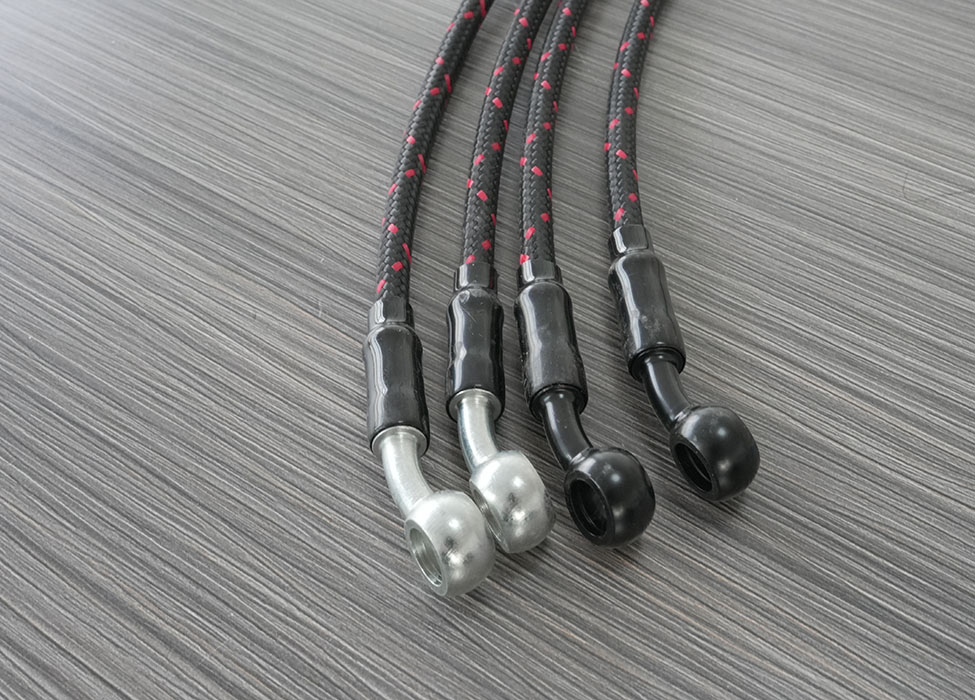
- The Real-World Effect: This translates to an immediate, firm pedal with minimal travel. The "bite point" is consistent and predictable, lap after lap, stop after stop. This technology is why our colored blue, red, and black hydraulic brake lines are not just for show—they are functional upgrades that deliver this precise feel.
The Impact of Heat: Expansion's Worst Enemy
Expansion isn't a fixed number. It gets worse with temperature. As brake fluid and caliper heat soaks into the lines (especially those near the wheels or engine), the hose material softens.
- A rubber hose that's adequate at 20°C can become unacceptably mushy at 120°C.
- A PTFE/stainless line's performance remains virtually unchanged across its entire operational range (from -70°C to over 260°C). This thermal stability is critical for track use, mountain driving, or operating in the extreme heat of the Middle East.
Tired of a Mushy Brake Pedal? Let's Talk Solutions.
If you're chasing a firm pedal and consistent braking, addressing line expansion is one of the most effective upgrades you can make. The choice of material—and its color—depends on your goals. Are you building a show-stopping bike with pink lines, a clean JDM build with silver, or a stealthy performance car with black? The core performance benefit is the same. Tell us about your vehicle and how you use it, and we'll recommend the right line to eliminate sponge and give you back control. Contact us for a technical consultation.
Brake Line Expansion FAQ
Can I feel the difference between rubber and braided lines on the street?
Yes, especially during moderate to firm braking. The initial "bite" will feel sharper and more immediate with braided lines. The difference is most pronounced during repeated stops, like in traffic or on a winding road, where standard rubber hoses heat up and soften, increasing expansion.
Does a thicker rubber hose expand less?
Not necessarily. A thicker wall might marginally improve burst pressure, but if the base material is still elastic rubber, it will still expand under pressure. The key is the reinforcement. A braided stainless steel over-braid is far more effective at restraining expansion than any textile or soft steel mesh used in OEM hoses.
Do all braided stainless lines perform the same?
No. Quality is determined by the density and tensile strength of the stainless braid and the quality of the PTFE liner. A loose, cheap braid will still allow more expansion than a tight, high-quality weave. Our lines, like the green and blue hydraulic brake lines, use a high-density braid for minimum expansion and maximum durability.