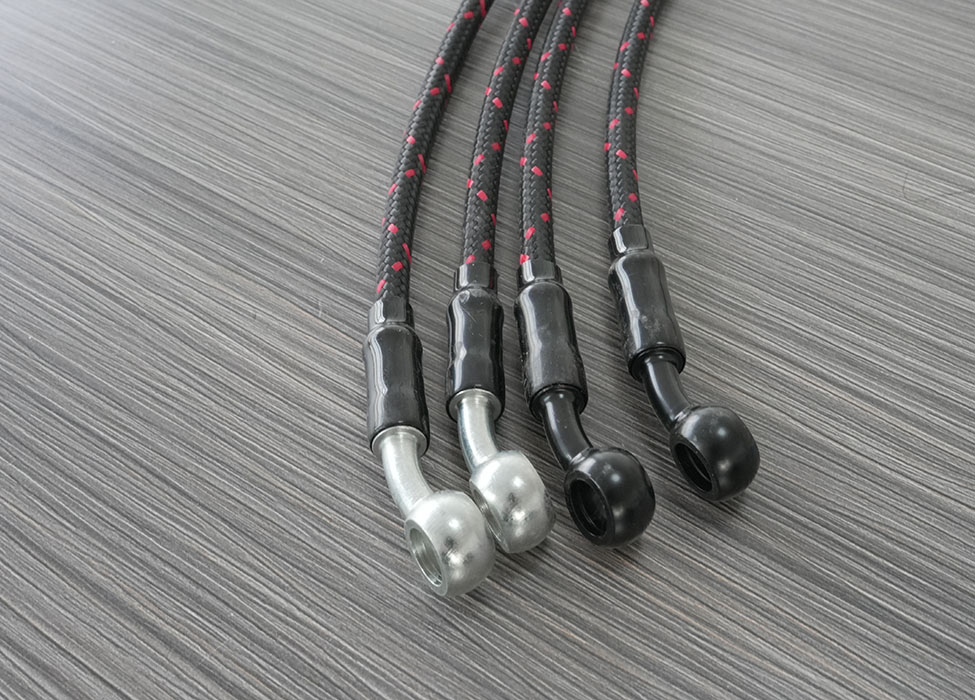
The Engineering of Prevention: Material Science Behind Corrosion-Resistant Brake Lines
Combating brake line corrosion is more than just applying a thicker coating; it's a deliberate application of material science and mechanical design. For engineers, fleet specifiers, and serious enthusiasts, understanding the "why" behind the upgrade leads to better purchasing decisions and longer-lasting vehicles. Let's examine the technical specifications that separate a corrosion-prone part from a lifetime component.
Deconstructing the Weak Points of a Standard Hose Assembly
A typical rubber brake hose assembly has several inherent vulnerabilities:
- Carbon Steel Fittings: Usually with a thin zinc plating (often yellow zinc). This plating provides limited sacrificial protection. Once scratched or worn through, the underlying steel rusts rapidly, especially in the presence of salt.
- Rubber/EPDM Outer Jacket: While flexible, it is permeable to air and moisture over time. It offers little to no protection against abrasion from road debris.
- Adhesion at the Crimp: The rubber is crimped onto the metal fitting. Corrosive agents can wick into this microscopic interface, breaking the bond and causing leakage—a common failure mode that is often misdiagnosed.
The High-Performance Blueprint: Layer-by-Layer Defense
Quality braided lines are engineered to address each weakness systematically.
1. The Inner Liner: PTFE (Teflon®)
Material Property: Polytetrafluoroethylene is a fluoropolymer with almost universal chemical inertness. It is non-reactive with brake fluid, water, and salts.
Corrosion Benefit: It creates a perfect, non-permeable barrier. This completely isolates the brake fluid (and any absorbed moisture) from the structural reinforcement layer, eliminating internal corrosion of the hose body. This is a fundamental advantage over rubber.
2. The Reinforcement & Primary Armor: Stainless Steel Braid
Material Choice: Type 304 (AISI 304) stainless steel is standard for its excellent balance of corrosion resistance, strength, and cost. For marine or extreme environments, Type 316 offers higher molybdenum content for better resistance to chlorides (salt).
Mechanical & Corrosion Benefit: The tight, woven braid provides tremendous tensile strength with minimal radial expansion. As a corrosion barrier, the chromium in stainless steel forms a passive, self-healing oxide layer (Cr2O3) on the surface that prevents further oxidation (rust). Even if scratched, this layer reforms in the presence of oxygen.
3. The Critical Interface: Advanced Fittings and Crimping
Fitting Material: We use zinc-nickel plated low-carbon steel or 303 stainless steel fittings. Zinc-nickel plating offers 5-7x the corrosion resistance of standard zinc plating in salt spray tests (ASTM B117).
Crimping Technology: The fitting is crimped directly onto the PTFE inner liner and stainless braid. This creates a superior, direct metal-to-metal-and-polymer seal that is less susceptible to the wicking failure seen in rubber-to-metal crimps. The connection itself is more robust and sealed against ingress.
Specification and Selection for Optimal Lifecycle Cost
When evaluating brake lines for a harsh environment, use this checklist:
- Inner Core: Specify PTFE. Avoid "reinforced rubber" for critical applications.
- Braid Material: 304 Stainless Steel is excellent for most applications. For direct saltwater exposure, inquire about 316.
- Fitting Finish: "Zinc-Nickel" or "Stainless Steel" are the only acceptable answers. Avoid descriptions like "plated" or "gold zinc" without specifics.
- Color Consideration: The colored coating on lines like our blue or pink hydraulic brake line is a powder coat or anodized layer that provides an additional environmental seal and UV protection for the underlying braid, adding to longevity.
Beyond the Hose: System-Level Corrosion Management
Upgrading the flexible lines is the most impactful single change, but for a complete solution:
- Hardlines: Consider replacing severely corroded steel hardlines with CuNiFer (copper-nickel-iron) alloy line. It is vastly more corrosion-resistant, easier to flare, and is OE-approved on many European vehicles.
- Fluid Management: Use a high-performance brake fluid with a high dry and wet boiling point. Change it every two years, without exception. This controls internal acidity and moisture.
- Ancillary Components: Inspect and lubricate caliper slide pins annually with appropriate high-temperature silicone grease. Corroded pins can cause uneven pad wear and sticking, masking as other problems.
Technical Q&A
Q: Does the stainless steel braid ever corrode?
A: In the presence of chlorides (salt) and under stress, stainless steel can experience "stress corrosion cracking," but this is exceptionally rare in automotive brake line applications. The more common issue is surface discoloration or "tea-staining," which is superficial and does not affect strength. Choosing a quality 304 or 316 braid minimizes this.
Q: Are all colored lines created equal?
A: No. The quality of the color application matters. A thin, painted coating will chip and flake. Our colored lines, such as the red hydraulic brake line and green hydraulic brake line, use a durable process that bonds the color to the braid, ensuring it doesn't compromise the corrosion resistance or flexibility of the underlying stainless steel.
Q: We need to certify brake lines for a specific market (e.g., GCC, Japan). Can you support this?
<st