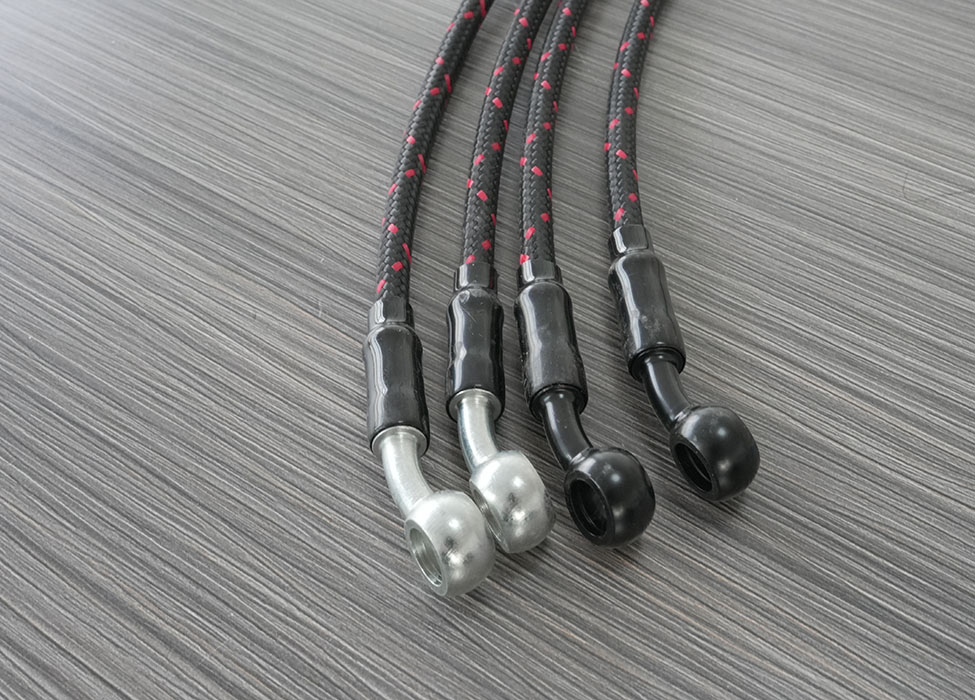
How to Choose the Right Stainless Steel Braided Brake Hose
Choosing a stainless steel braided brake hose is not simply a matter of selecting a color or hose length. For motorcycles, modified cars and other hydraulic braking applications, the hose must match the brake system in terms of inner tube material, reinforcement, fittings, working pressure, temperature range, length and installation requirements.
For distributors, importers and motorcycle parts buyers, choosing the correct specification is also important for repeat orders. A brake hose that looks correct but has the wrong fitting, thread specification or bend angle can create installation problems and unnecessary replacement costs.
1. Start With the Brake System Application
The first step is to determine where the brake hose will be installed. Motorcycle front brake systems, rear brake systems, modified motorcycles, scooters, cars and performance vehicles can require different hose lengths, fitting configurations and routing arrangements.
Before ordering, confirm whether the hose is intended for a front brake, rear brake, clutch hydraulic system or another hydraulic application. If it is a replacement product, the original hose or a clear drawing can be used as a reference.
Common Applications
- Motorcycle front and rear brake systems
- Modified and performance motorcycles
- Scooters and electric motorcycles
- Passenger cars and modified vehicles
- Aftermarket brake upgrade kits
- OEM replacement brake hose assemblies
For motorcycle applications, our Motorcycle Brake Lines can be manufactured according to different vehicle configurations, hose lengths and fitting requirements.
2. Choose the Correct Inner Tube Material
The inner tube is directly exposed to brake fluid, so its material is one of the most important parts of the hose construction.
PTFE or Teflon inner tubes are commonly selected for high-performance brake hose applications because of their chemical resistance, temperature capability and dimensional stability. The reinforcement layer is then used to control expansion and provide mechanical strength.
PTFE Inner Tube With Stainless Steel Braid
A typical high-performance braided brake hose consists of a low-expansion inner tube, stainless steel braided reinforcement and an outer protective covering. The exact construction should be selected according to the intended application and required performance specifications.
For buyers comparing different suppliers, it is useful to ask for the actual hose construction instead of comparing products only by appearance.
3. Pay Attention to Hose Reinforcement
Stainless steel braid provides mechanical reinforcement around the inner tube. The braid construction, wire diameter, braid density and production process can influence the finished hose characteristics.
For a modified brake hose, reinforcement is particularly important because the hose is part of a hydraulic system. The objective is not simply to make the hose look stronger. The complete hose assembly needs to be designed around pressure, flexibility, routing and fitting requirements.
4. Select the Correct Fittings
Many installation problems are caused by incorrect fittings rather than the hose itself.
When ordering a custom brake hose, buyers should provide as much fitting information as possible, including fitting type, thread specification, fitting angle and connection style.
Important Fitting Information
- Banjo or straight fitting
- Fitting angle
- Thread specification
- Fitting material and surface finish
- Connection orientation
- Required fitting length
If the original assembly is available, sending a sample to the manufacturer can reduce communication errors during development.
5. Measure the Correct Hose Length
Brake hose length should not be estimated only by looking at the vehicle. The hose must follow the actual routing path between the master cylinder, caliper and other connection points.
A hose that is too short can create tension during steering or suspension movement. A hose that is unnecessarily long can create routing and installation problems.
Recommended Measurement Method
- Follow the original hose routing.
- Measure between the actual connection points.
- Record the fitting angle at both ends.
- Check clearance from moving or hot components.
- Confirm whether additional length is required for the intended routing.
6. Color Is a Customization Option, Not a Performance Specification
Color is important for aftermarket motorcycle products because customers often want a specific appearance. However, color itself does not determine brake hose performance.
Our production range can include different colors for customized brake hose applications, including:
- Blue Hydraulic Brake Line
- Green Hydraulic Brake Line
- Red Hydraulic Brake Line
- Black Hydraulic Brake Line
For technical selection, buyers should prioritize hose construction, fittings, dimensions, pressure requirements and brake fluid compatibility before selecting the outer color.
7. Stainless Steel Braided Brake Hose Maintenance
A braided brake hose should still be inspected regularly even when stainless steel reinforcement is used.
- Check for leakage around crimped fittings.
- Inspect the outer covering for damage.
- Check for abnormal bending or twisting.
- Inspect fittings for corrosion or physical damage.
- Make sure the hose does not rub against sharp edges.
- Check the routing after suspension or steering components have been modified.
Replacement intervals should follow the vehicle manufacturer's recommendations and the actual condition of the hose. There is no universal replacement interval that applies to every vehicle and every operating environment.
8. What Should Buyers Check Before Ordering?
For importers and distributors, product consistency is often more important than simply finding the lowest unit price.
Before placing a bulk order, confirm:
- Inner tube material
- Braid material and construction
- Hose outside diameter
- Working and test pressure requirements
- Temperature range
- Hose length tolerance
- Fitting specifications
- Fitting orientation
- Crimping method
- Color requirements
- Packaging and labeling
- Sample approval procedure
9. Our Main Brake Hose Product Range
As a brake hose manufacturer, we support different hydraulic brake hose configurations for motorcycle, automotive and aftermarket applications. Depending on the project, products can be supplied as hose assemblies or customized according to drawings and samples.
Our product range includes stainless steel braided hydraulic brake lines, motorcycle brake lines, PTFE-based brake hose assemblies and different color options for aftermarket applications.
Buyers looking for a specific appearance can also review our Pink Hydraulic Brake Line and Silver Hydraulic Brake Line options.
10. FAQ About Stainless Steel Braided Brake Hoses
How often should brake hoses be replaced?
There is no single replacement interval suitable for every application. Follow the vehicle manufacturer's maintenance schedule and inspect the hose condition regularly. Hoses showing leakage, cracking, abrasion, deformation or damaged fittings should be evaluated for replacement.
Does upgrading to a braided brake hose really improve safety?
A properly designed and correctly installed braided brake hose can provide better control of hose expansion compared with some conventional hose constructions. However, braking safety depends on the complete hydraulic system, including the master cylinder, caliper, brake fluid, fittings, installation and maintenance. A hose upgrade should not be treated as a guarantee of improved braking safety by itself.
Are aftermarket braided brake hoses suitable for all vehicles?
No. The hose must match the vehicle and braking system specifications. Length, fittings, thread configuration, routing and brake fluid compatibility all need to be checked before installation.
Can you manufacture custom brake hoses from a drawing or sample?
Yes. A drawing, existing hose sample, fitting information or technical specification can be used as a reference for custom development and quotation.
If you have a drawing, existing sample or specific hose style, send the information to our technical team so we can check the construction, fittings and dimensions for your application.
Contact our brake hose factory for technical support and a custom quotation.