Recent News
-
 2026-2-2
Why Choose Retrofit Brake Lines?

Brake feel is one of the first things a rider notices when operating a motorcycle. A brake lever that feels soft, inconsistent or slightly delayed can make it harder to control braking precisely, especially during repeated hard braking.
While brake pads, discs and calipers receive most of the attention when discussing braking performance, the brake hose also plays an important role. The hose is responsible for transferring hydraulic pressure from the master cylinder to the brake caliper.
For this reason, replacing an aging conventional hose with a correctly specified stainless steel braided brake line can change the way the brake lever feels. The improvement is mainly related to hose expansion, pressure transmission, construction and installation.
When the rider pulls the brake lever, the master cylinder generates hydraulic pressure. Brake fluid then transfers this pressure through the brake line to the caliper.
The caliper converts hydraulic pressure into mechanical force, pushing the brake pads against the disc.
A flexible brake hose has to withstand hydraulic pressure while allowing movement between components. Conventional rubber hoses are designed with flexibility in mind, but the hose wall can expand to some degree when hydraulic pressure increases.
That expansion is small, but the amount of expansion can influence how the lever feels, particularly when the braking system is operated at higher pressure.
A stainless steel braided brake line normally uses an inner fluid tube surrounded by reinforcement. The braided layer helps control the dimensional change of the hose when hydraulic pressure is applied.
When the hose expands less under pressure, the lever input can feel more direct and consistent. This does not mean that the brake line creates additional braking force by itself. Instead, it can reduce unwanted hose deformation within the hydraulic system.
A firmer brake lever does not necessarily mean that the braking system has become more powerful. It usually means that the relationship between lever movement and hydraulic response feels more controlled.
A properly constructed reinforced hose can control radial expansion better than some conventional hose constructions.
When the hose maintains its shape more effectively under pressure, the rider may notice a more consistent response during repeated braking.
On performance motorcycles, riders often pay attention to the point where the brake pads begin to engage. A more consistent hydraulic response can make this engagement point easier to judge.
Actual brake feel still depends on the master cylinder ratio, caliper design, brake pad compound, disc condition, brake fluid, bleeding quality and hose installation.
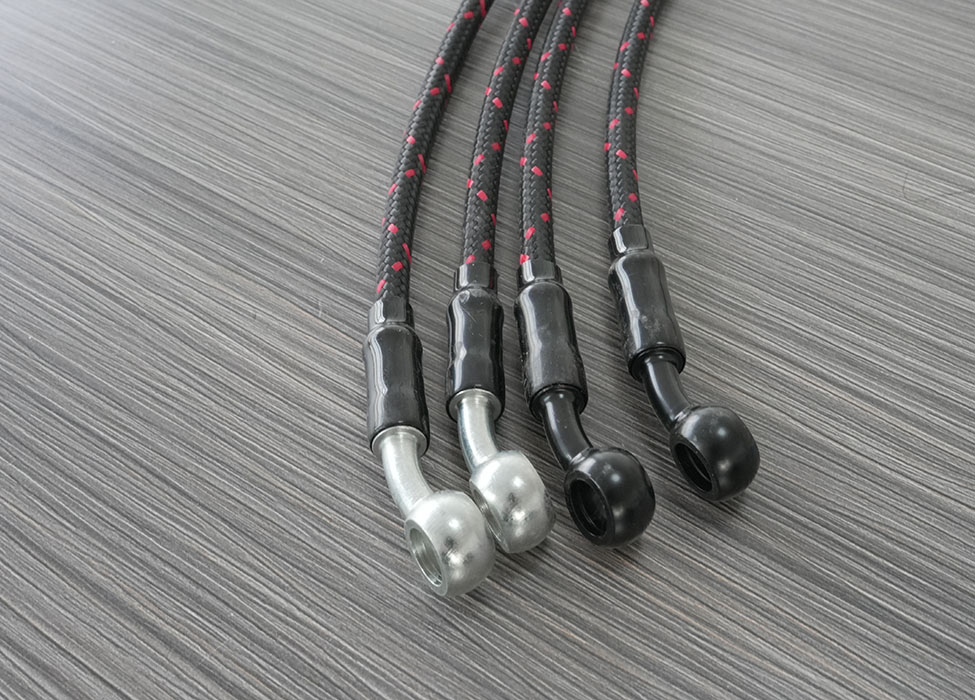
Motorcycle Brake Lines are not simply flexible tubes. Length, internal construction, fitting angle, thread specification and routing all need to match the motorcycle.
This becomes particularly important on modified motorcycles where the original handlebars, front forks, calipers or master cylinder may have been changed.
A hose that is too short can become stretched when the handlebar reaches full steering lock. A hose that is excessively long can create unnecessary loops and may contact moving components.
The angle of a banjo or other end fitting affects how the hose sits after installation. A technically correct hose can still create installation problems if the fitting orientation is wrong.
For modified motorcycles, color is often part of the overall build. However, color should be considered after the technical specification has been confirmed.
Blue Hydraulic Brake Line is commonly selected for motorcycle customization projects where a colored hose is required to complement blue bodywork, wheels or other modified components.
For wholesale buyers, the important specifications should still include hose construction, length, fitting configuration and application rather than color alone.
Red Hydraulic Brake Line is suitable for performance-style motorcycle builds and aftermarket brake hose projects where a visible red finish is preferred.
It can be specified according to the required hose length and fitting configuration for different motorcycle applications.
Black Hydraulic Brake Line provides a more understated appearance and is suitable for riders or brands that prefer an OEM-style visual finish while using a customized brake line.
This is an important distinction.
A stainless steel braided brake line does not automatically increase the mechanical braking force of a motorcycle. Brake performance is determined by the complete system, including the master cylinder, caliper, pads, disc, brake fluid and hydraulic pressure.
The main potential advantage of the hose upgrade is improved control of hose expansion and more consistent hydraulic response.
Check for broken braid wires, severe abrasion, corrosion or damage around areas where the hose contacts brackets or other components.
Inspect the connection points for leakage, movement or signs of mechanical damage.
On motorcycles, turn the handlebar fully left and right and confirm that the hose does not become stretched, twisted or sharply bent.
Remove road dirt and contamination regularly, particularly on motorcycles used in wet, dusty or coastal environments.
For OEM customers, distributors and motorcycle parts brands, the correct brake line is often easier to develop from an existing sample or drawing than from a general product description.
If you are unsure about the correct hose construction, fitting angle or length, send us your drawing, sample, photos or dimensions. Our engineers can review the requirements before production.
Contact our brake hose manufacturer for customized motorcycle brake lines, samples and bulk orders.
There is no universal replacement interval for every motorcycle. Service life depends on hose material, age, temperature, UV exposure, mechanical movement and installation conditions. Regular inspection and the motorcycle manufacturer's maintenance recommendations should be followed.
A correctly designed and installed braided brake line can provide more consistent hydraulic behavior and brake feel. However, it should not be treated as a standalone safety upgrade. The complete braking system must be correctly specified and maintained.
No. Hose length, fittings, thread specifications, routing and brake system configuration differ between motorcycles. The replacement hose must match the specific application.
We manufacture customized brake lines for motorcycles and other vehicle applications. Hose length, fitting configuration, appearance and other specifications can be developed according to customer drawings, samples and technical requirements.
