Recent News
-
 2026-2-2
Why Choose Retrofit Brake Lines?

A common and dangerous issue reported by mechanics and drivers worldwide is brake drag—when the pads fail to fully retract from the rotor after braking. This leads to excessive heat, premature pad/rotor wear, reduced fuel economy, and in severe cases, brake fade or fire. For our clients in hot climates like the Middle East and Africa, this problem is exacerbated. This technical guide breaks down the primary causes, with a focus on how upgraded brake lines are often the definitive solution.
The most straightforward diagnostic for brake drag is the temperature check. After a normal drive without aggressive braking, safely use an infrared thermometer or carefully place your hand near (not on) each wheel. A significantly hotter wheel indicates the brake on that corner is dragging.
This is the most overlooked culprit. A standard rubber brake hose can fail internally. The inner tube can delaminate, creating a flap that acts like a one-way valve. It allows pressure to flow to the caliper to apply the brake but restricts the fluid from returning when you release the pedal. The caliper piston cannot retract fully, causing constant pad contact.
Heat, age, and contaminated brake fluid cause the rubber to break down. In our factory tear-downs, we see swollen inner liners that reduce the hose's internal diameter, creating a permanent restriction.
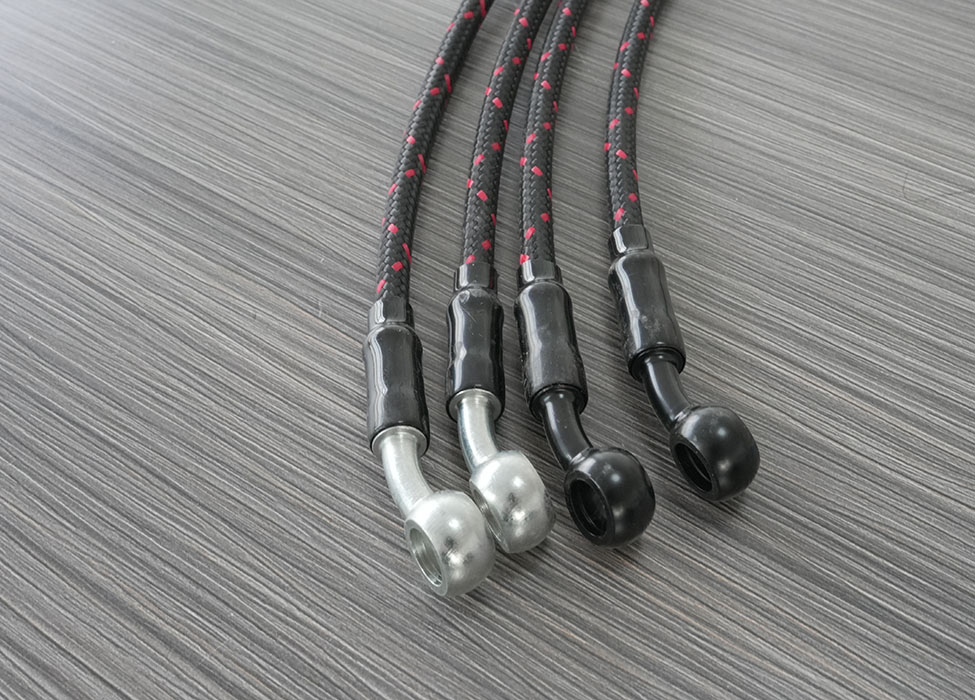
Our braided hydraulic brake lines solve this permanently. The core is a seamless PTFE (Teflon) tube, which is chemically inert and cannot swell or delaminate. The surrounding stainless steel braid prevents external damage. Upgrading to a set of Red Hydraulic Brake Lines or Black Hydraulic Brake Lines ensures an unobstructed fluid path for both application and release, eliminating hose-induced drag.
Corrosion, dirt, or degraded grease can cause the caliper piston or the sliding pins on floating calipers to seize. The caliper cannot "float" back from the rotor, holding the pads in contact.
This is not a hose issue, but a maintenance one. Caliper slide pins should be cleaned and re-greased with high-temperature silicone brake grease annually, especially in regions with road salt or heavy dust (common in Africa and the Middle East).
On older vehicles with a rear drum brake, an incorrectly adjusted pushrod or a failing master cylinder primary seal can prevent the system from fully releasing pressure. On all vehicles, a defective master cylinder can maintain residual pressure in the lines.
For drag-prone applications, material matters. Here’s our recommendation:
Q: How can I tell if my brake hose is collapsed?
A> A definitive test requires system pressure checks, but a strong indicator is a one-sided drag. If one wheel is consistently hotter, and the caliper slides move freely, the hose on that side is the prime suspect. Replacing it with a braided line is a reliable fix.
Q: Are braided brake lines just for race cars?
A> Absolutely not. They are a direct OEM replacement for any vehicle. Their superior durability and consistent performance make them a safety upgrade for daily drivers, especially in demanding climates. They prevent the internal failures that cause drag.
Q: My vehicle has an electronic parking brake. Can I still upgrade the lines?
A> Yes. The hydraulic brake line system is separate. Our lines replace the standard hydraulic hoses. The electronic parking brake mechanism is typically a separate motor on the caliper and is not affected.
About Our Factory: We are a specialized manufacturer of high-performance brake hoses and lines. Our product range includes the full spectrum of colored Braided Hydraulic Brake Lines for automotive and motorcycle applications, all designed to meet strict SAE/DOT standards.
Need a Custom Solution or Technical Drawing Review? We support custom lengths and fittings for modified applications. Contact our engineering team with your specifications for a prompt quote.
