Diagnosing Brake Drag: A Hidden Culprit in Your Brake System and How to Fix It Permanently
As a brake system engineer with extensive field experience across diverse climates from the Middle East to Southeast Asia, I've consistently found brake drag to be a common yet frequently misdiagnosed problem. It's not just a minor annoyance—it leads to excessive pad and rotor wear, reduced fuel economy, and increased operating costs, especially for fleet vehicles. This guide provides a systematic approach to identifying the root causes, with a special focus on how flexible brake line health is directly linked to this issue.
Understanding Brake Drag: More Than Just a Sticking Caliper
Brake drag, or "brake binding," occurs when the brake pads fail to fully retract from the rotor after the pedal is released. This creates constant friction, generating heat, wearing components prematurely, and increasing rolling resistance. The causes are often interlinked, starting with the hydraulic system's ability to properly release pressure.
Primary Cause 1: Restricted Brake Hose – The Hydraulic "Check Valve" Effect
This is the most overlooked cause. A standard rubber brake hose that has begun to degrade internally can act like a one-way valve. Here's the mechanics:
- Internal Delamination: The inner lining of the hose separates from the reinforcement braid. When you apply the brakes, fluid pressure can force its way to the caliper. However, when you release the pedal (creating a slight vacuum in the line), the delaminated inner liner can collapse or fold inward, blocking the return path of the fluid from the caliper back to the master cylinder.
- Symptom: The caliper piston is held under residual pressure, causing the pads to drag. The vehicle may feel sluggish, and one wheel will be noticeably hotter than the others after a drive.
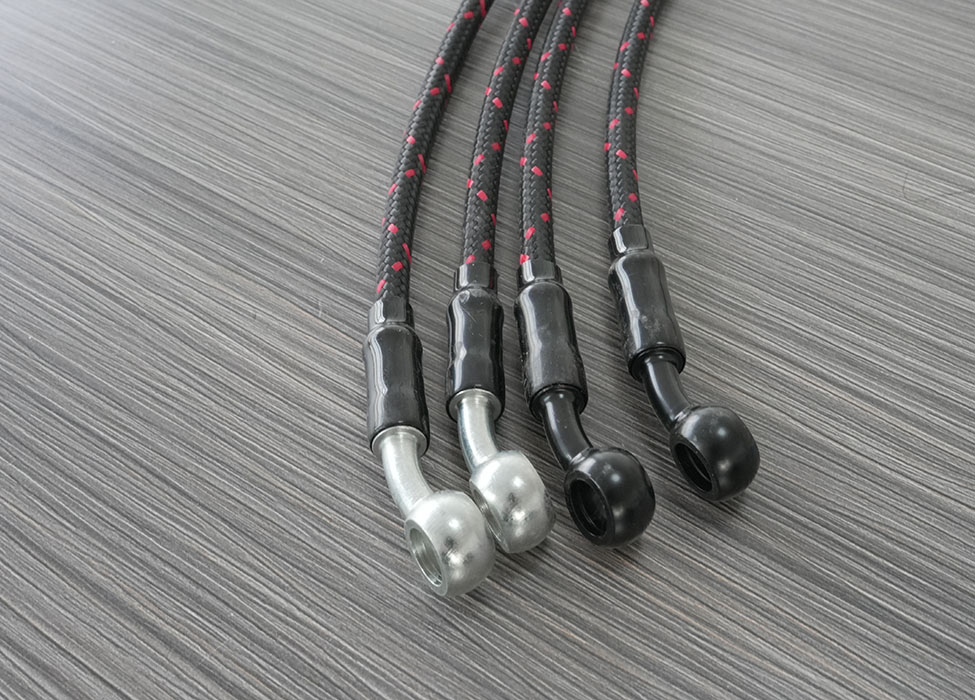
- The Definitive Fix: Replace with a performance hose featuring a non-collapsible core. Our Blue Hydraulic Brake Line and Black Hydraulic Brake Line are built with PTFE (Teflon) inner cores. PTFE is structurally rigid and maintains a perfect cylindrical bore, ensuring zero restriction on fluid return, thereby eliminating this failure mode entirely.
Primary Cause 2: Sticking Caliper Pistons or Slide Pins
Corrosion and contamination are the enemies. In humid, coastal regions of Southeast Asia and Japan, or dusty environments in the Middle East and Africa, brake dust and moisture cause slide pins and piston boots to seize.
- Diagnosis: Lift the vehicle and try to spin the wheel. If there's significant resistance, check for heat. Then, using proper tools, try to compress the caliper piston back into its bore. A piston that is very difficult to retract is likely corroded and sticking.
- Maintenance Key: During every pad change, the slide pins must be removed, cleaned, and re-lubricated with high-temperature silicone grease. The piston boot should be inspected for tears.
Primary Cause 3: Faulty Master Cylinder or Residual Pressure Check Valve
Less common but possible. A master cylinder that does not fully release pressure, or a malfunctioning residual pressure valve (sometimes found in drum brake systems or aftermarket proportioning valves), can hold pressure in the lines.
- Diagnosis: If drag occurs on all wheels simultaneously, the master cylinder is suspect. Carefully open a bleeder valve on a dragging caliper (with the system depressurized). If a burst of fluid is released and the drag is immediately relieved, the pressure is coming from upstream (master cylinder or valve), not from a stuck caliper.
Why Upgrading to Braided Hydraulic Lines is the Critical First Step
Before chasing other potential causes, eliminating the brake hose as a variable is both cost-effective and a significant performance upgrade. Here’s what sets our products apart:
- PTFE Core Integrity: The polytetrafluoroethylene (PTFE) liner in our Red Hydraulic Brake Line and Silver Hydraulic Brake Line cannot swell, delaminate, or collapse. It guarantees a consistent, unrestricted flow in both directions—apply and release.
- Stainless Steel Braid Containment: The braid provides immense hoop strength, preventing the hose from expanding under pressure. More importantly, it provides a rigid external structure that supports the PTFE core, preventing any external force (like a kink) from deforming the fluid passage.
- Superior Fluid Compatibility: PTFE is inert to all standard brake fluids (DOT 3, 4, 5.1), preventing the internal chemical degradation that leads to gumming and restriction in rubber hoses.
Buyer's Guide: Selecting the Right Line to Prevent Drag
For High-Heat & Off-Road Use (Middle East, Africa): Prioritize lines with a PTFE core for maximum temperature resistance. Colors like Red or Silver are popular for their heat-resistant outer sleeves and durability against abrasion.
For Humid, Coastal Regions (Southeast Asia, Japan): Corrosion resistance is key. Ensure the stainless steel braid and fittings are of high quality (304 or 316 grade). Our lines with colored sleeves, like Blue or Green, offer excellent protection against salt spray and moisture.
For Custom & Aesthetic Builds: Our full spectrum, including Pink Hydraulic Brake Line, provides the same performance while allowing for personalization. The color is in the tough outer PVC sleeve, which also serves as an abrasion layer.
For Motorcycles: Brake drag is especially dangerous on two wheels. Our Motorcycle Brake Lines are designed with specific lengths and banjo fittings to ensure smooth operation and eliminate any chance of restriction-induced drag.
FAQ: Addressing Brake Drag Concerns for Global Customers
Q: How often should brake hoses be replaced to prevent issues like drag?
A: For rubber hoses in demanding operating environments, a proactive replacement at 4-5 years or 80,000 km is strongly recommended. Internal degradation starts long before external cracks appear. Our braided hydraulic lines, with their PTFE core and stainless construction, are designed to last the lifetime of the vehicle, making them a one-time upgrade for reliability.
Q: Do改装软管 really improve safety regarding brake drag?
A: Absolutely. Safety isn't just about stopping power; it's about predictability and system health. A dragging brake creates uneven and unpredictable wear, can lead to rotor warping, and in extreme cases, a total brake seizure. By using a hose that cannot internally restrict flow, you eliminate a major cause of drag, leading to more consistent performance and reducing the risk of a sudden, dangerous failure.
Q: Are your brake line kits suitable for all vehicle types, including older models?
A> Yes. We manufacture direct-fit kits for a vast range of passenger cars, SUVs, trucks, and motorcycles popular in your target markets. Our product listings, such as Black Hydraulic Brake Line, cover many applications. For vehicles not in our standard catalog, we specialize in custom solutions. As stated on our contact page, we are here to assist. You can send us a sample, diagram, or detailed specifications of your original hose, and we will manufacture a perfect, drag-proof set for your specific vehicle. Contact us here for custom inquiries.