Recent News
-
 2026-2-2
Why Choose Retrofit Brake Lines?

In the diagnostic tree for brake drag, the flexible hydraulic hose is often the last component checked, yet it is a frequent failure point. For technicians in high-temperature regions like the Middle East or high-humidity zones like Southeast Asia, understanding the specific failure mechanisms of the brake hose is essential. This article provides a material science perspective on how a degraded hose causes drag and makes the technical case for Teflon-core, stainless braided lines as a definitive engineering solution.
A healthy brake hose is a passive, two-way conduit. A failing hose can become an active, pathological component in the system.
Standard multi-layer rubber hoses consist of an inner tube, a reinforcing textile braid, and an outer protective cover. Over time, heat cycles and electrochemical degradation cause the inner tube to separate from the reinforcing layer (delamination).
In more severe cases, the hose can suffer a permanent internal collapse, often due to external pinching or extreme internal degradation. This creates a chronic flow restriction, not just blocking return fluid, but also impeding the initial flow to the caliper, leading to a combination of drag and a hard pedal feel.
Your operating region directly impacts hose longevity and failure mode.
Consistent under-hood and near-brake heat, common in the Middle East and Africa, accelerates the breakdown of the synthetic rubber polymers. The inner liner becomes soft and gummy, drastically increasing its tendency to delaminate and stick. A hose with a PTFE (Teflon) core is unaffected by this heat, maintaining its mechanical properties up to 260°C (500°F).
In coastal areas of Japan, Korea, and Southeast Asia, moisture and salt create a perfect environment for electrochemical degradation. This process attacks the hose from the inside if moisture-contaminated fluid is present, and from the outside via salt corrosion. The stainless steel braid on a performance line provides a hermetic barrier against this external attack.
Upgraded brake lines are designed from first principles to avoid the material failures of rubber.
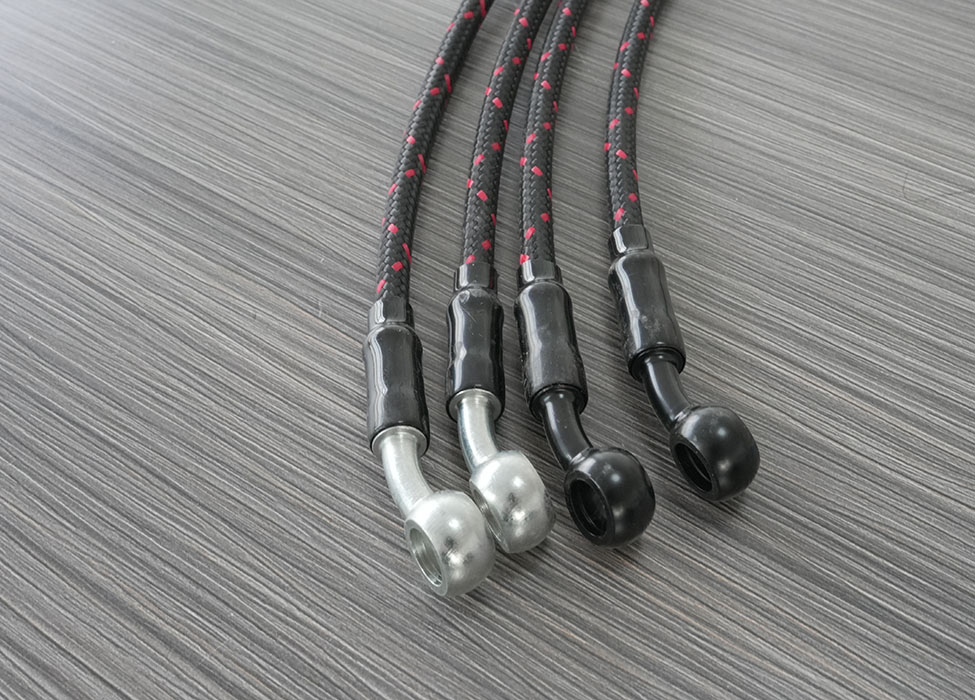
Polytetrafluoroethylene is a fluoropolymer with almost no chemical reactivity. It does not absorb brake fluid, does not swell, and cannot delaminate because it is a monolithic, extruded tube. Whether in a stealthy black line or a vibrant pink line, the PTFE core ensures a consistently smooth, reliable bore for the life of the product.
The braid serves two critical functions regarding drag:
Drag can also be caused by a slight internal leak at a fitting that allows pressure to bleed off slowly, but not completely. Our lines use precision-machined fittings and permanent crimps that exceed OE standards, ensuring the integrity of every connection point in the hydraulic circuit.
Our products are manufactured to meet or exceed key international standards such as SAE J1401 and are compliant with DOT requirements. We can provide necessary test reports and documentation to support customs clearance and market approval in your region, a concern we know is paramount for our partners in the Middle East, Africa, and Asia.
Absolutely, from a Total Cost of Ownership (TCO) perspective. The initial cost is offset by: 1) Elimination of repeat drag-related repairs (calipers, rotors, pads). 2) Reduced vehicle downtime. 3) Improved fuel economy across the fleet. 4) Extended service intervals for the brake lines themselves. For high-utilization vehicles, it is a financially sound decision.
Yes. The motorcycle brake line market is a key focus. We have kits for popular sports bikes, cruisers, and adventure tourers across Japanese and European brands. Colored lines like green or silver are especially popular in the customization segment.
We are a factory dedicated to brake line solutions. Our range is built on a foundation of material integrity and precise engineering:
• Ultimate Performance & Durability: Silver Stainless Braided Lines – The benchmark for reliability.
• Performance with Customization: Colored Braided Lines in Red, Blue, Green, Pink, and Black.
• Specialized Applications: Custom lengths and fittings for modified, classic, and commercial vehicles.
Final Recommendation: When diagnosing brake drag, move the flexible hose higher on your list of suspects. Its failure mode is subtle but destructive. Replacing it with a performance-grade braided line is not an aesthetic mod; it is a fundamental upgrade to the reliability and safety of the hydraulic system.
Have a persistent drag case or need a custom configuration? Reach out to our engineering team. We provide direct factory support to help you solve technical challenges and specify the correct product.
