Recent News
-
 2026-2-2
Why Choose Retrofit Brake Lines?

Every week we get this question from workshops in Southeast Asia, the Middle East and Africa: a brake hose got nicked, cracked or started weeping fluid — can they just patch it and keep going? Short answer: no, not safely. Here's why, and what you should do instead.
A brake hose doesn't carry compressed air or low-pressure fuel. It carries DOT 3 / DOT 4 / DOT 5.1 fluid at working pressures that routinely hit 80–120 bar under hard stops, and spike well above that at the instant the pads bite. The hose you're looking at was engineered as a single, bonded, pressure-bearing assembly: an inner fluid liner, one or more layers of reinforcing braid, and an outer rubber jacket — all crimped permanently to metal end fittings.
The moment you cut, wrap, clamp or epoxy any section of it, you've destroyed that engineered pressure boundary. There is no field-repair kit on the market rated by any standards body (FMVSS 106, ISO 3996, ECE R13) for a spliced brake hose. If a shop tells you it can be "repaired," walk away.
In our shop, the most common failure modes on OE rubber hoses are:
A patch only addresses the outer symptom. The delamination, the corrosion, the plumping — all still there.
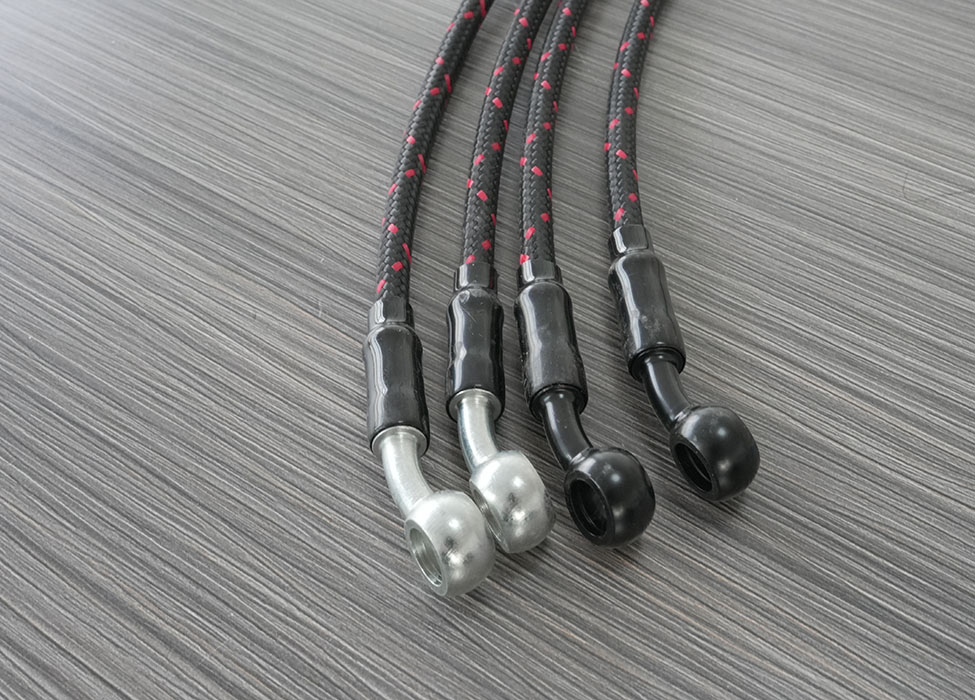
The reason riders, racers and fleet operators switch to stainless braided lines is that the underlying material problem goes away. A modern performance brake line is built around a PTFE (Teflon) inner core sheathed in a 304 stainless steel outer braid. PTFE doesn't swell, doesn't age in ozone, doesn't delaminate, and chemically shrugs off DOT fluid. The braid contains it dimensionally so there is essentially zero volume change under pressure.
Depending on the vehicle and use case, we typically steer customers to one of these:
If the damaged hose is on a rare bike, a lifted 4×4, a race car, or a Middle-East-spec commercial vehicle, the fastest path is to send us a photo or sketch of the original. We need four things:
Send the drawing or sample to us and we'll quote within 24 hours. Get in touch here → or email your sketch directly — we ship samples worldwide.
OEM rubber hoses are typically inspected every 2 years and replaced around 4–6 years or 60,000–80,000 km, whichever comes first — regardless of mileage. Rubber ages by time, not just distance. PTFE/stainless braided lines have no scheduled replacement interval; we've pulled 10+ year-old braided lines off track bikes that tested still within spec.
Honest answer: they don't shorten stopping distance in a straight line. What they do is remove pedal sponginess under repeated/heavy braking — the moment when faded rubber lines expand and turn a confident stop into a "pump the pedal" event. That consistency is what most riders and drivers describe as "the brake feels new again." For vehicles that tow, carry loads, or run hot climates (Gulf, Southeast Asia), the difference is obvious on the first hard stop.
Almost universally yes, but not as a universal one-size kit. The fittings, length and routing have to match the chassis. If you send us the original hose, a clear photo, or a drawing with dimensions, we build to spec. We also support OEM customization — if you have a drawing of your own, we produce to it. Typical lead time for custom runs is 15–20 working days.
