Beyond the Sponge: How Climate and Use Accelerate Brake Line Expansion Problems
A new car's brakes feel tight. Fast forward five years, or after a season of aggressive driving, and the pedal has lost its edge. While pad wear is part of it, the degradation and increased expansion of the brake lines themselves is a major, often ignored, factor. This degradation isn't uniform—it's dramatically accelerated by specific environmental and usage patterns common in our key markets across Asia, the Middle East, and Africa. Let's examine the external forces that turn a minor expansion characteristic into a major performance and safety issue.
Environmental Attack: How Climate Degrades Hose Integrity
1. The Heat Challenge (Middle East, Desert Africa, Track Use)
High ambient temperature is public enemy number one for rubber components. Under-hood temperatures in desert climates or after spirited driving can routinely exceed 100°C.
- Effect on Rubber: Heat accelerates the chemical process called "polymer chain scission," where the long molecules in the rubber break down. This makes the rubber softer, stickier, and more prone to permanent deformation (set). A heat-cycled rubber hose becomes permanently more flexible, leading to increased expansion under pressure.
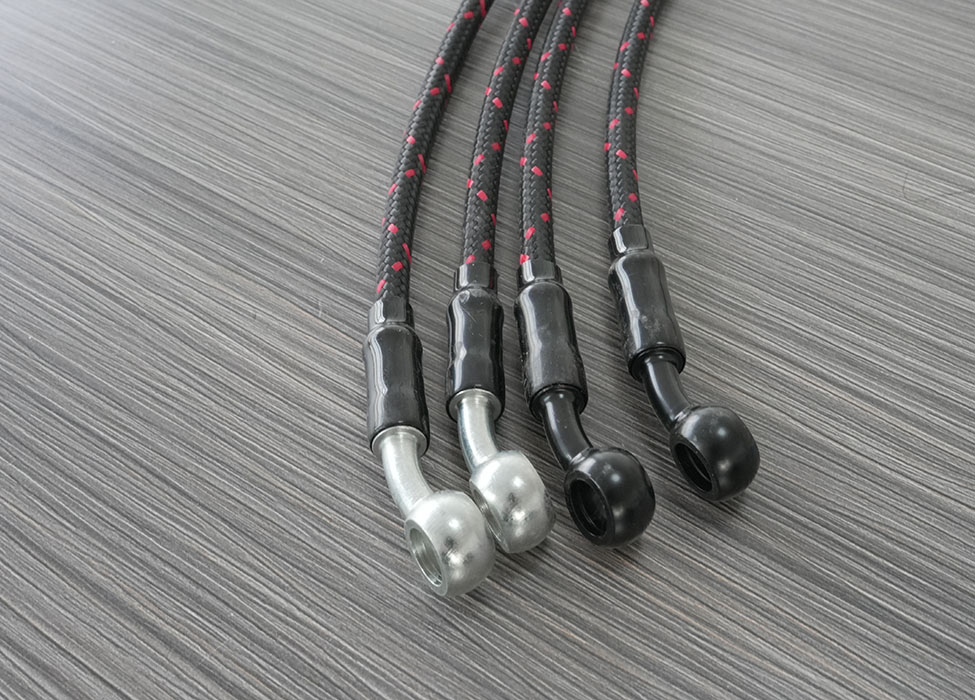
- The Solution's Advantage: PTFE (Teflon) has a crystalline structure that is unaffected by these temperatures. Our braided lines, whether in classic silver or bold red, maintain their mechanical integrity and low-expansion characteristics even in extreme heat, making them essential for reliable performance in these regions.
2. The UV & Ozone Challenge (Global, Especially High-Altitude)
Sunlight and ozone in the atmosphere are powerful oxidizing agents.
- Effect on Rubber: They attack the surface of rubber hoses, causing them to become dry, brittle, and cracked—a condition called "weather checking" or "dry rot." While this starts externally, it compromises the structural layers of the hose, weakening the reinforcement and making the hose more susceptible to expansion and eventual failure.
- The Solution's Advantage: The stainless steel braid on our lines provides a complete UV and ozone barrier for the critical inner liner. The colored exterior coatings on our blue, green, and pink hydraulic brake lines are also formulated for UV resistance, protecting both appearance and function.
3. The Fluid Contamination Challenge (All Regions, Especially with Old Fluid)
Brake fluid is hygroscopic—it absorbs water from the air. This is accelerated in humid climates like Southeast Asia and coastal Japan.
- Effect on the System: Water in the fluid lowers its boiling point dramatically and causes internal corrosion in the master cylinder, steel lines, and calipers. The resulting rust particles and acidic sludge can abrade the inner wall of rubber hoses, making them thinner and weaker.
- Effect on Rubber: Some rubber compounds can also absorb small amounts of moisture from the fluid, causing them to swell slightly from the inside, effectively reducing the internal diameter and altering the material properties.
- The Solution's Advantage: PTFE is completely non-porous and chemically inert. It does not absorb moisture or react with contaminated brake fluid. The bore size and material properties remain constant, ensuring consistent performance and protecting the rest of the system from circulated debris.
Usage Patterns That Expose Expansion Weaknesses
Performance & Track Driving
Repeated high-pressure braking generates immense heat in the fluid and at the caliper, which conducts into the hose. A rubber hose will heat-soak, becoming progressively spongier over a session. This is "pedal fade" distinct from pad fade. Upgrading to braided lines is the first recommended mod for any track car to maintain consistent pedal feel.
Towing and Heavy Loads (SUVs, Trucks)
Stopping a heavily laden vehicle requires higher line pressures. This increased working pressure pushes standard hoses closer to their expansion limits. For vehicles used for towing or overlanding, the added security of a minimal-expansion line is a valuable safety margin.
Motorcycle Applications
On a motorcycle, brake feel is everything. The limited lever travel magnifies any sponginess. Furthermore, Motorcycle Brake Lines are often shorter and exposed to more engine heat. The combination makes upgrading from rubber to braided stainless lines one of the most perceptible improvements a rider can make, offering better modulation and control at the lever.
Is Your Environment or Driving Style Killing Your Brake Feel?
Living in a hot, humid, or sunny climate? Driving your car hard or using it for work? These factors are actively degrading your brake hoses and increasing expansion. Don't just live with a deteriorating pedal. Proactively upgrade to a hose designed to withstand your specific conditions. Whether you need the heat resistance of a braided line for your UAE daily driver or the corrosion resistance for your bike in coastal Japan, we have a solution. Tell us where you drive and how you use your vehicle for a tailored recommendation.